


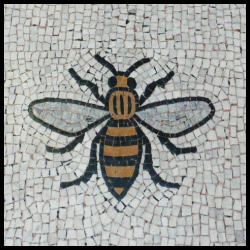
The History of the Manchester Bee
Did you know that the worker bee is the symbol of Manchester? More than just an emblem of industry, it reflects a community with a history deeply rooted in hard work, resilience, and looking out for one another.
The story dates back to 1842. As Manchester flourished as a global hub of trade, often known as Cottonopolis, the city’s early leaders sought a coat of arms that would reflect its ethos of enterprise. They chose an image of seven bees encircling a globe, representing Manchester’s work and trade across the seven seas. Unlike cities built on royal patronage or vast natural resources, Manchester owed its success entirely to its people. The bee, an individually small but collectively a superorganism, perfectly mirrored the efforts of Mancunians shaping their own destiny. Together, we are stronger.
You can find this history proudly carved into the exterior of Manchester Town Hall. Just as bees tirelessly work to support the hive, generations of Mancunians worked the cotton mills that fuelled the city’s prosperity. It was a fitting choice; the bee is an industrious little grafter. And quite apart from the symbolism, bees are simply amazing, jaw-droppingly stunning creatures.
In recent years, the Manchester bee has taken on an even deeper meaning. In the aftermath of the arena bombing in 2017, it became a quiet, powerful symbol of unity, solidarity, and defiance. Its image appeared on walls, posters, and memorials across the region, a reminder of how closely the city pulls together when times are hardest.
Today, that collective spirit is turning toward the environment. Local people are working together to blur the division between the urban and the rural. Planters are appearing on street corners, green walls are flowering, and even apartment dwellers are greening their balconies to welcome pollinators back into the city centre. By embracing these small, sustainable changes, Manchester is finding a balance between its industrial heritage and its green future.
After many difficult decades in the mid-twentieth century, Manchester is thriving once again. Today, a striking new skyline of skyscrapers reflects its rapid growth as a modern centre for business, sport, culture, and major international conferences, attracting visitors from all over the world.
The iconic bee mosaic, which is seen all around, is taken from the famous mosaic floors inside Manchester Town Hall. Originally laid by Venetian craftsmen, the building’s 4,500 yards of marble flooring primarily feature cotton flowers. Outside the Great Hall at Manchester Town Hall is a spectacular mosaic floor featuring 67 bees. The design became one of the key inspirations for the modern Manchester bee symbol used across the city today.
As we look to the future, we hope that you will find time to visit Manchester, see these beautiful mosaics in person, and explore everything this remarkable city has to offer.
So next time you are wandering around Manchester, or arriving at Manchester Airport and catch sight of a bee, you will know exactly why.